

Google Gemini AI:
“Madani” is a word with several significant meanings, depending on the context:
Malaysia Madani (Political/Government Policy)
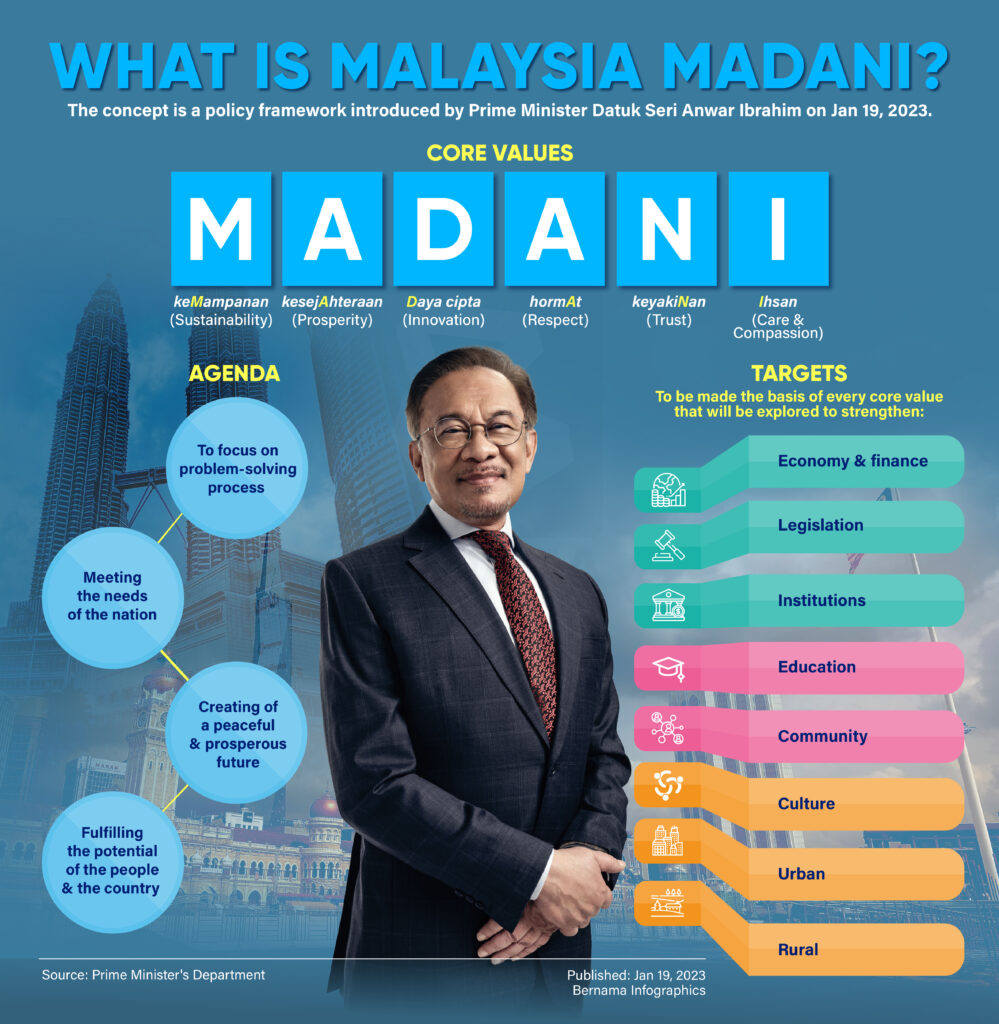
In the contemporary Malaysian context, Malaysia Madani is a policy framework and government slogan introduced by Prime Minister Anwar Ibrahim. In this context, MADANI is a Malay acronym for six core values:
MADANI:
- Mampanan (Sustainability)
- Akuntabiliti/KesejAhteraan (Prosperity)
- Daya Cipta (Innovation)
- Akhlak/HormAt (Respect)
- Nilai-nilai Murni/KeyakiNan (Trust)
- Ihsan (Care and Compassion)
- Madani generally translates to “Civilized Malaysia” and focuses on good governance, sustainable development, and racial harmony.
Madani in an Islamic Context
The word is derived from the Arabic word “Madinah,” which means “city.” In Islamic history and studies, “Madani” refers to:
Related to Madinah: Anything associated with the city of Madinah (formerly Yathrib), where the Prophet Muhammad (peace be upon him) migrated.
Qur’anic Verses: It is a classification used for the chapters or verses of the Qur’an that were revealed after the Prophet Muhammad’s migration (Hijrah) to Madinah. These verses typically focus on establishing a just and cohesive society, legal matters, social structures, and practical implementation of faith. This is in contrast to Makki verses, which were revealed before the Hijrah and mainly focus on monotheism, faith, and morality.
Madani Society (Masyarakat Madani): This concept, often used by Muslim intellectuals, refers to a civilized, just, and ideal society—a civil society—often taking inspiration from the society established by the Prophet Muhammad in Madinah.
Literal and Linguistic Meaning
Literally, as an Arabic-loan word, Madani means “civil,” “civilized,” or “pertaining to a city” (as opposed to “Bedouin” or “rural”).
So, what “Madani” means depends on whether you are referring to the Malaysian political framework, the classification of Qur’anic texts, or the general concept of a civilized society in an Islamic context.
Deepseek AI:
The term “Madani” has several distinct meanings, ranging from a general concept to a specific political framework. Based on the search results, here are the main interpretations:
Malaysia Madani: A Policy Framework
· Core Values: The word “Madani” itself is an acronym for six core values:
· ke Mampanan: Sustainability
· KesejAhteraan: Prosperity
· Daya Cipta: Innovation
· Hormat: Respect
· KeyakiNan: Trust
· Ihsan: Compassion
· Policy Domains: This concept targets key areas like the economy, legislation, education, and culture.
General Meaning: “Civilized”
In the Malay and Indonesian languages,”madani” is an adjective that means civilized. It describes a society or people who are advanced in terms of reasoning, spirituality, and wealth.
As a Personal or Family Name
· A name for someone from the Islamic holy city of Medina (Arabic: Al-Madīnah).
· More generally, a word meaning “townsman” or city dweller.
Summary
· Current Affairs / Politics: Almost certainly refers to the Malaysia Madani policy.
· Language / Dictionary: Refers to the general adjective meaning “civilized”.
· People / Genealogy: Likely refers to a surname of Arabic origin.
ChatGPT 5.0 AI:
🌙 Meaning & Origin
- Derived from Arabic مدني → civil, civilized, urban, or related to Medina.
- Strongly tied to Medina, where Prophet Muhammad established the first Islamic community.
- Connotations: piety, learning, social ethics, civil society, community-oriented life.
📖 In Islamic Scholarship
- Madani Surahs → Qur’anic chapters revealed after migration to Medina.
- Madani society → model of justice, ethics, and social order established by the Prophet.
🕌 Modern Islamic Thought
- Masyarakat Madani (Madani Society) → popularized in 1995 by Anwar Ibrahim.
- Refers to a democratic, ethical civil society inspired by Islamic values.
🏫 Institutions, Places & Organizations Named “Madani”
- Educational institutions → schools, madrasahs, universities signaling Medina-inspired curriculum and civic values.
- Religious centers → mosques, Islamic centers, da’wah groups emphasizing prophetic teachings and community development.
- Cultural & social organizations → NGOs/foundations highlighting social justice, ethical governance, empowerment.
- Geographical/institutional naming → cities, districts, programs evoking civic responsibility, Islamic heritage, social harmony.
🧭 In Short
- Madani is both a religious-cultural concept rooted in Medina and a modern institutional label.
- It blends tradition (piety, ethics, community) with contemporary aspirations (justice, education, civil society).
The Concept of Madani was expounded by Mr Yusmadi Yusoff in a Public Forum on 13th December Saturday at The Refinery

This is Mr Yusoff’s speech below
MADANI, Civilisation, and the Birth of a New Modern Asian Civilisation
Speech by Yusmadi Yusoff
Singapore, 13th December 2025
Good afternoon, and thank you for the invitation.
It is a pleasure to be here in Singapore.
For me, coming to Singapore is never simply crossing a border.
It feels more like moving within the same civilisational space — a shared history, shared anxieties, and increasingly, shared questions about the future.
Today, I would like to speak about MADANI, not as a slogan or a policy label, but as a civilisational idea — and why it matters for ASEAN, for education, and for the kind of Asia we are becoming.
The Missing Question
ASEAN is often described in transactional terms: a fast-growing market, a competitive regional bloc, a hub for talent and investment.
All of this is true. But it is incomplete.
What is often missing is a deeper question — one that Asia has asked before at pivotal moments in its history:
What kind of civilisation are we becoming?
This question lies at the heart of MADANI.
What Is MADANI?
When I speak about MADANI, I am not referring to a political slogan, and not to a religious doctrine.
I am referring to a civilisational framework — a way of thinking about how modern societies live together ethically in an age of speed, technology, and constant pressure.
MADANI asks a very practical question:
In a fast, competitive, technologically advanced world,how do we remain humane, cohesive, and trustworthy?
I explain MADANI using a simple civilisational SCRIPT.
S — Sustainability
Development that does not exhaust the environment, institutions, or human beings.
C — Care and Compassion
Ensuring that efficiency does not come at the expense of dignity, especially for the vulnerable.
R — Respect
Respect across race, religion, culture, and nationality — not as tolerance, but as a daily civic habit.
I — Innovation
Embracing technology and creativity, while asking what they are for and whom they serve.
P — Prosperity
Prosperity understood as sejahtera — well-being, not merely GDP.
T — Trust
Trust as the invisible infrastructure of society. Without trust, no system — however efficient — can last.
In many ways, societies like Singapore already practise parts of MADANI very well.
The question MADANI raises is how we protect conscience, reflection, and humanity as we move even faster.
ASEAN as One Campus
If ASEAN is to move from brand competition to civilisational confidence,
we must begin to see ourselves not merely as a collection of markets,
but as one shared intellectual and moral space.
I like to think of ASEAN as one campus.
In this campus: courts become classrooms, villages become laboratories, cities become spaces of ethical experimentation.
Cross-border mentorships — between Malaysia, Singapore, Indonesia, and beyond — are as important as student exchanges.
Education here is not only about credentials. It is about forming leaders capable of cooperation amid diversity.
In this sense, ASEAN is not merely a regional organisation. It is — potentially — a school of civilisation.
A Birthplace of a New Modern Asian Civilisation
Malaysia and Singapore occupy a unique civilisational position.
Few places in the world see Islamic, Confucian, Hindu, and Western traditions interacting daily — not at the margins, but at the mainstream of law, economics, politics, and education.
The result is not simply multicultural coexistence.
It is a civilisational synthesis — modern, ethical, diverse, and pragmatic.
This interaction has produced an idea of development and modernity that Asia can offer the world.
In this sense, our region represents a birthplace of a New Modern Asian Civilisation.
Universities and the Moral Heart of Civilisation
More than a thousand years ago, around 942 CE, the philosopher Al-Fārābī — known in the West as Alpharabius, “The Second Teacher” after Aristotle wrote about the Virtuous City (al-Madīnah al-Fāḍilah).
He argued that a civilisation flourishes not through wealth or force, but through the ethical and intellectual formation of its people.
In his vision, education is the moral heart of civilisation, and knowledge exists to guide society toward sa‘ādah — human flourishing and happiness.
Applied today, this challenges modern universities.
A MADANI university must go beyond producing degrees.
It must be embedded in society — sharing space with farms, clinics, courts, places of worship, and libraries.
Teachers become mentors. Knowledge serves justice and human flourishing.
A Forgotten Moment in Our History
This is not the first time our region has stood at such a crossroads.
In 1947, the Carr–Saunders Committee produced a report on higher education in Malaya, largely shaped by colonial administrative needs.
A young lawyer and scholar — trained at Raffles College and serving as a Municipal Councillor in Singapore — was asked for his views.
Instead of submitting a memorandum, Ahmad Ibrahim responded with a book, written in Jawi and published in 1949, titled Universiti di Malaya.
He argued that a university must not merely supply manpower, but cultivate a moral intelligentsia rooted in the civilisation of the land.
That same year, the University of Malaya was established.
Today, ASEAN stands at a similar trajectory — under different realities, but confronting the same essential question:
What kind of university does our civilisation now require?
Dialogue, Not Clash
In 1995, at the University of Malaya, scholars including Samuel P. Huntington, Tu Wei-Ming, William Chittick, and Wang Gungwu gathered under the leadership of Anwar Ibrahim together with Professor Osman Bakar for an Islam–Confucian dialogue.
This was a deliberate response to the pessimism of the “Clash of Civilizations” thesis.
The message remains relevant today:
Civilisations are not destined to collide. They can converse and co-create.
Given that Islam and Confucian-influenced cultures together shape a large part of humanity, this dialogue is not merely philosophical. It is civilisational — social, cultural, political, and economic.
A Choice for ASEAN
ASEAN now faces a choice.
We can continue to optimise for speed, branding, and rankings. Or we can consciously shape a civilisation that integrates technology with ethics, diversity with trust, and progress with humility.
The birth of a New Modern Asian Civilisation is not guaranteed. But the ingredients already exist — in history, philosophy, and the lived experience of our region.
The future of Asia will not be determined only by how fast it grows, but by the kind of civilisation it chooses to become.
Thank You.
If you prefer to watch Yusmadi’s speech
you can do it here
To view all the speeches given by the Speakers,
click on this link
If you want to know more about Madani Foundation,
click on this link
Leave a Reply