

One of the purposes of Future of Singapore website is to curate useful articles about Singapore here
4th March 2026

For younger students in Primary 1 to 3, Desmond Lee said there will be a “very light supervised use of technology”, including AI. This is because children at that age learn best through tactile touch, such as going outdoors and for learning journeys, he added.
From Primary 4 onwards, students will begin learning how to use AI with close supervision to understand what it can be used for. AI tools will also be integrated into platforms such as the Student Learning Space (SLS) to personalise support.
18th May 2026
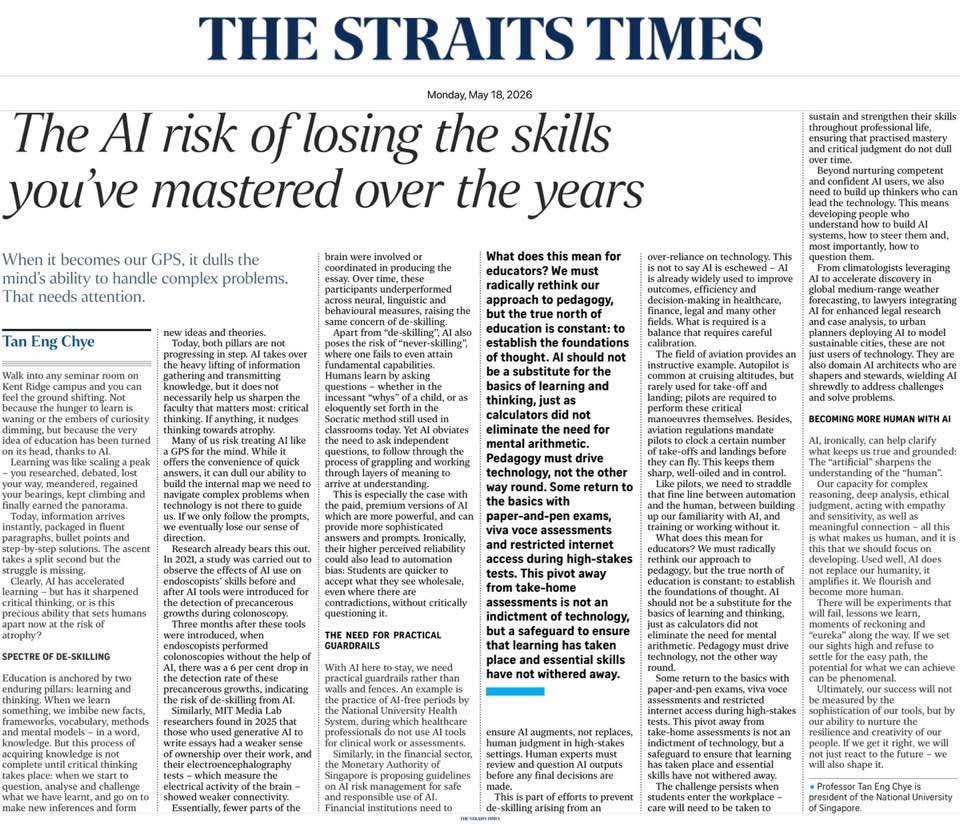
The above article was published on the Straits Times on 18th May 2026. It was written by Mr Tan Eng Chye, the President of National University of Singapore, NUS.
Ex-Editor of the Straits Times, Ms Bertha Henson also has something to say about this.

Bertha Henson:
I am so, so glad that the President of NUS has written an op-ed on the dangers that AI poses to learning. It’s something that I am keenly aware of because I use AI a lot, paying for premium versions. I used to be pleasantly surprised at what AI can do. But now there is an ever louder signal in my brain; a dawning realisation that the “thinking human’’ can go extinct easily.
//Learning was like scaling a peak – you researched, debated, lost your way, meandered, regained your bearings, kept climbing and finally earned the panorama.
Today, information arrives instantly, packaged in fluent paragraphs, bullet points and step-by-step solutions. The ascent takes a split second but the struggle is missing.
Clearly, AI has accelerated learning – but has it sharpened critical thinking, or is this precious ability that sets humans apart now at the risk of atrophy?//
Answering his question, I would say yes because I also see it happening to my own brain. While AI can add to my knowledge store, it still means I have to ask if it got it right or whether the perspective is skewed. But that is so inconvenient and time-consuming and negates the benefits of using AI, no?
Many of us risk treating AI like a GPS for the mind. While it offers the convenience of quick answers, it can dull our ability to build the internal map we need to navigate complex problems when technology is not there to guide us. If we only follow the prompts, we eventually lose our sense of direction.
So true. Premium AI comes up with its own series of follow-up questions to its OWN answer, tempting the user to follow its thesis through. You feel thoroughly educated, as if you have ‘learnt’ something. But in reality, what has happened is that you have been ‘fed’ something. And it is not brain food.
It’s actually quite hard to distinguish between AI as augmentation of human skills and AI as a replacement. Whatever intentions you have when you start to use AI, you will be lured into using it more and more and in many different waysbecause it is so easy to outsource your thinking to a chatbot.
Education is anchored by two enduring pillars: learning and thinking. When we learn something, we imbibe new facts, frameworks, vocabulary, methods and mental models – in a word, knowledge. But this process of acquiring knowledge is not complete until critical thinking takes place: when we start to question, analyze and challenge what we have learnt, and go on to make new inferences and form new ideas and theories.
Today, both pillars are not progressing in step. AI takes over the heavy lifting of information gathering and transmitting knowledge, but it does not necessarily help us sharpen the faculty that matters most: critical thinking. If anything, it nudges thinking towards atrophy.
In all that AI hullabaloo, how often have we asked ourselves if we are competent enough to handle its seductions? We seem to be treading so carefully, to keep in step with the narrative that our economy has to be infused with AI. AI training and AI education is in vogue. Have we even stopped to, well, think?
My own view is that even now, there isn’t much of a display of critical thinking skills. That’s evident in what public service media serves up as news reports to the masses. It repeats, just like how some people who use AI repeat what it says to the rest of the world. If our daily reading diet is so sterile, how do we even build brain muscle?
I would also be surprised if educators say that their students are full of questions. In my own experience, they prefer getting answers from their teachers so that they can, yes, repeat them. Teachers jug, students mug. This is already the case without AI, what more if they can use AI to come up with answers in very convincing and elegant form? Teachers would have to be even more careful about grading them, even as they use AI as some sort of grading tool!
Am I going to be one of those “de-skilled’’ people whom Mr Tan talks about? I can safely say that journalism, as it is now pursued in Singapore, is a role at risk of AI substitution. AI can tell me immediately if a certain newsmaker has posted on FB, or when an agency has issued an update. And it can give me the news in one paragraph or 20. Unless original reporting or new information is uncovered, AI can do a better job of summarising the news or even expanding the breadth and depth with research that is already publicly available.
As someone in love with language, let me tell you my other big worry. We don’t need to write in proper sentences and spel words correctly when we chat with AI. Somehow it figures out your question and even puts it in plain English for you.
Language skills are devalued, not that plain English is cherished in a society that doesn’t place much store on the study of humanities.
With AI, you don’t even need to say please and thank you because you are the ‘master’. But who is the master, really
Here’s another good article about AI and Jobs from local Poet and Singapore Author
Gwee Li Sui

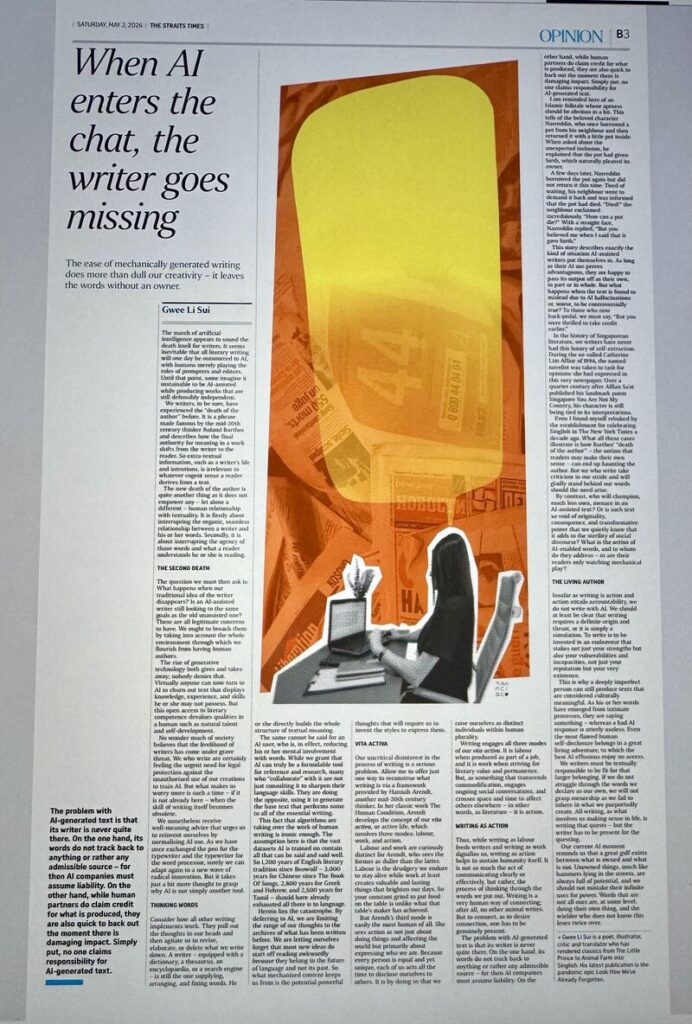
Here’s another article about Education and AI
and Bertha’s take on it
Published in the Straits Times, 4 May 2026:
https://www.straitstimes.com/singapore/parenting-education/ngee-ann-poly-grads-to-get-free-ai-courses-as-over-25000-students-graduate-across-five-polytechnics

What Bertha says:
//All Ngee Ann Polytechnic (NP) graduates can attend four free courses on artificial intelligence, including a new course designed to help individuals effectively blend AI capabilities with human-centric skills.//
What does human-centric skills mean? Are they suppose to make AI have human-centric skills? And since when has being human been reduced to ‘skills’. I ‘think we should be careful about the way AI is reported. The human comes FIRST. In any case, the article does not explain what this new course is although it’s flagged in the intro.
Just this: //The four free courses NP is offering to its graduates include the newest Human-First AI Core, which aims to equip learners with the thoughtful application of AI. //
Total rubbish reporting. What does it mean and how is it different from other courses? I guess other courses equip learners with anything-goes AI?
Bertha further writes:
It’s getting real obvious that people are using AI to write their posts. It’s not the em dash. It’s the long-windedness of the post that is the giveaway. It shows that there is no editing and no focus and no consideration for the reader. The chatbot is just answering a prompt. Then you repeat and pass off its answer as yours.
I use AI a lot, mainly for research. Even so, I am glad that I have enough domain knowledge and a good editor’s eye to spot inaccuracies and more importantly, contradictions in its answers. And enough instincts to look for verification and confirmation when some bits of an ‘answer’ don’t seem right.
It’s amazing how the chatbot can draft you long answers that are clearly aligned with what you would like to see. And passing it off as ‘analysis’ in convincing style.
This is faster, after all, than a person reading up for himself, looking at pros and cons, what other people say and reaching a bottomline ON his own. A bottomline which might actually confound his perceptions and lead to a re-assessment of his position….
In case you havent noticed, we are NOT good at asking questions, much less higher-level questions that will give answers with some depth. Go sit in a classroom or attend a local press conference.
If we want AI to automate routine processes, that is fine. But not if we unthinkingly use it to do our thinking for us, especially when we don’t have a brain filled with the relevant knowledge to question it further.
All this promotion about being AI-centric or AI-focused or enabled is scary. It is a very thin line between getting it to DO things and getting it to THINK for us. When I see comments on social media that proudly proclaim that this what AI says as though it came from the mouth of God, I wonder if the poster is mad. It is not done in the interest of transparency, but a BOAST.
As schools get on the AI bandwagon, we MUST have critical thinking skills run alongside AI courses. I would say that foundational knowledge and critical thinking skills come FIRST so that AI will never over-ride brain muscle work or fill it with slop.
PS. Sometimes I wish public service media would run their first drafts past AI with a prompt that says : Make this more readable. After all, the info has been already collected and a focus decided on. Not, however, if they input a mass of text like a speech, ask AI to do its own research and come up with an article in XX words. If so, journalism is definitely an ‘at-risk’ job. What value does the human bring to the table except original reporting and original content that can’t be reached through AI?
Editor’s Note:
Overuse of AI without Critical Thinking and Analysis dumbs people down. That is why we really need to think about WHAT we are thinking and putting words on paper or on the screen. The process of writing should make you THINK.
Bertha is upset and justifiably so by the loose terms people like to throw about nowadays.
27th April 2026
Pamela Lim, an Educational Technologist had this to say:
The AI Classroom Is Obsolete
Walk into most classrooms running an AI lesson today and the problem appears immediately.
You will see digital-native children being taught prompts they mastered months ago, by teachers who have never built or deployed anything with AI in the real world.
We have seen this pattern before.
When tablets arrived, schools introduced devices after students were already learning on YouTube. When social media reshaped culture, universities added modules after students were already building audiences on Instagram. Each time, institutions arrived late, formalised yesterday’s skills, and called it progress.
In digital marketing the gap was filled by the market. General Assembly, HubSpot Academy, Google Digital Garage and similar programmes produced the talent universities could not. The standard path became clear: get the degree, do the bootcamp, get hired.
That model worked because the cycle was still slow enough. A university could lag by a year. A bootcamp could catch up in twelve weeks. You arrived in time.
AI ends that timeline.
In under two years the market moved from chat prompts to agents, multimodal systems and coding copilots. OpenAI’s o1, Anthropic’s computer use, Google’s NotebookLM — each arrived and shifted expectations in a single semester. By the time a syllabus is approved, parts of it are already outdated.
The floor keeps rising. Basic prompting becomes assumed. The field splits into layers — retrieval, evaluation, tuning, safety, orchestration — faster than any curriculum committee can meet.
And unlike past revolutions, AI is recursive. Learners use AI to learn AI. I watched a sixteen-year-old iterate from GPT-3.5 to a local fine-tuned Llama deployment in eight weeks, through YouTube, open-source forums, and trial and error. No classroom touched that arc.
The cheating asymmetry makes the point bluntly. By the time teachers adopt one detection tool, students have already used stronger generation tools to defeat it. Detection is reactive, institutional, and slow. Evasion is iterative, personal, accelerated by the same technology. It is not a fair race. It is not even a race.
This is not a failure of discipline. It is a structural mismatch between institutional response time and technological change.
The degree-then-bootcamp formula that rescued digital marketing cannot rescue AI. Neither can the university cycle, nor state training systems built for slower industries. Those systems were designed for stable trades: define competencies, approve curriculum, fund courses, certify workers. AI does not stay still long enough for that machinery to complete one turn.
This does not mean AI cannot be taught. It means it cannot be taught through static curricula, delayed approvals and detached theory. It is learned through direct use, constant iteration, and building with tools that change in real time.
That means project-based apprenticeship. Mentors who are building today, not professors who published on symbolic AI in 2007. Assessment on output, not attendance. Curriculum updated every month, not every three years.
Funding can buy access. It cannot buy capability.
The current system is not merely slow. It is structurally mismatched to the task it has been assigned.
Here is the link to Pamela’s post in Facebook
Leave a Reply